
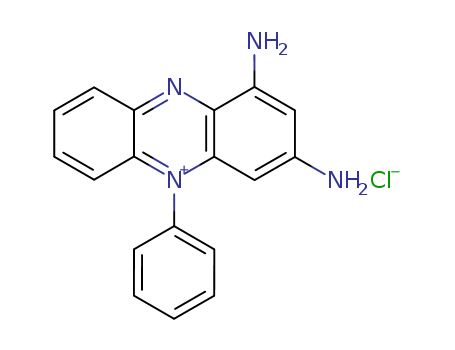
Details
Manufacturer supply high quality 1,3-diamino-5-phenylphenazinium chloride 19220-17-8 with ISO standards
- Molecular Formula: C18H15 N4 . Cl
- Molecular Weight: 322.797
- Boiling Point: °Cat760mmHg
- Flash Point: °C
- PSA: 68.81000
- Density: g/cm3
- LogP: 0.99550
1,3-diamino-5-phenylphenazinium chloride(Cas 19220-17-8) Usage
|
Chemical structure |
1,3-diamino-5-phenylphenazinium chloride |
|
Physical state |
Yellow water-soluble dye |
|
Application |
Used in cell viability and proliferation assays |
|
Mechanism of action |
Converted to a formazan product by mitochondrial reductases in living cells |
|
Measurement |
Formazan product can be measured spectrophotometrically to assess metabolic activity of cells |
|
Usage |
Widely used in biomedical research and pharmaceutical testing |
|
Purpose |
Evaluate the effects of drugs, toxins, and environmental factors on cell viability and proliferation |
|
Safety precautions |
Toxic if ingested or inhaled, can cause skin and eye irritation |
|
Handling |
Proper safety measures and protocols should be followed when working with this chemical |
|
General Description |
1,3-diamino-5-phenylphenazinium chloride, also known as MTT (3-(4,5-dimethylthiazol-2-yl)-2,5-diphenyltetrazolium bromide), is a yellow water-soluble dye often used in cell viability and proliferation assays. It is a redox indicator that is converted to a formazan product by mitochondrial reductases in living cells. The formazan product can be measured spectrophotometrically to assess the metabolic activity of the cells. MTT is widely used in biomedical research and pharmaceutical testing to evaluate the effects of drugs, toxins, and environmental factors on cell viability and proliferation. However, caution should be exercised in handling MTT as it is toxic if ingested or inhaled, and can cause skin and eye irritation. Proper safety measures and protocols should be followed when working with this chemical. |
InChI:InChI=1/C18H14N4.ClH/c19-12-10-14(20)18-17(11-12)22(13-6-2-1-3-7-13)16-9-5-4-8-15(16)21-18;/h1-11H,(H3,19,20);1H
19220-17-8 Process route
-

-
402766-67-0
N -phenyl-N '-picryl-o -phenylenediamine

-

-
19220-17-8
pinacryptol green
| Conditions | Yield |
|---|---|
|
With
hydrogenchloride; tin(ll) chloride;
|
-
-
19220-17-8
pinacryptol green
| Conditions | Yield |
|---|---|
|
Oxydation mit Luft;
|
19220-17-8 Upstream products
-
402766-67-0
N -phenyl-N '-picryl-o -phenylenediamine
Relative Products
- N-TERT-BUTYLISOPROPYLAMINE
- 2,3,5,6-TETRAMETHYL PHENOL
- 2-[2-(tetrahydro-2-furyl)ethyl]pyridine
- octahydro-3,5,5,8,8-pentamethylnaphthalene-2(1H)-one
- (E)-alpha-ethylidenepiperidine-1-acetaldehyde
- 3-[(2-aminocyclohexyl)methyl]-4-methylcyclohexylamine
- 1-(2-ethoxypropoxy)propan-2-ol
- Nonaethylene glycol
- 1-Octadecylpyridinium chloride
- 4,5-dihydro-2-pentadecyl-1H-imidazole-1-ethanol
- 3,4-dihydro-2,2,5-trimethyl-2H-pyrrole 1-oxide
- 1-[2-[(2-cyanoethyl)(1-oxodocosyl)amino]ethyl]-2-henicosyl-4,5-dihydro-1-methyl-1H-imidazolium methyl sulphate
- 4,5,6,7-tetrahydro-N,2-dimethyl-2H-indazol-3-ylammonium hydrogen maleate
- 4-amino-5-hydroxy-3-[(4-nitrophenyl)azo]-6-(phenylazo)naphthalene-2,7-disulphonic acid, sodium salt
- 4,4'-BIS(HEPTYLOXY)AZOXYBENZENE
- Isoamyl iodide
- LAS-C10
- 4,6-DIMETHYLPYRIMIDINE
- Tolmetin
- 1-benzyl-2-phenyl-1H-imidazole